[ad_1]
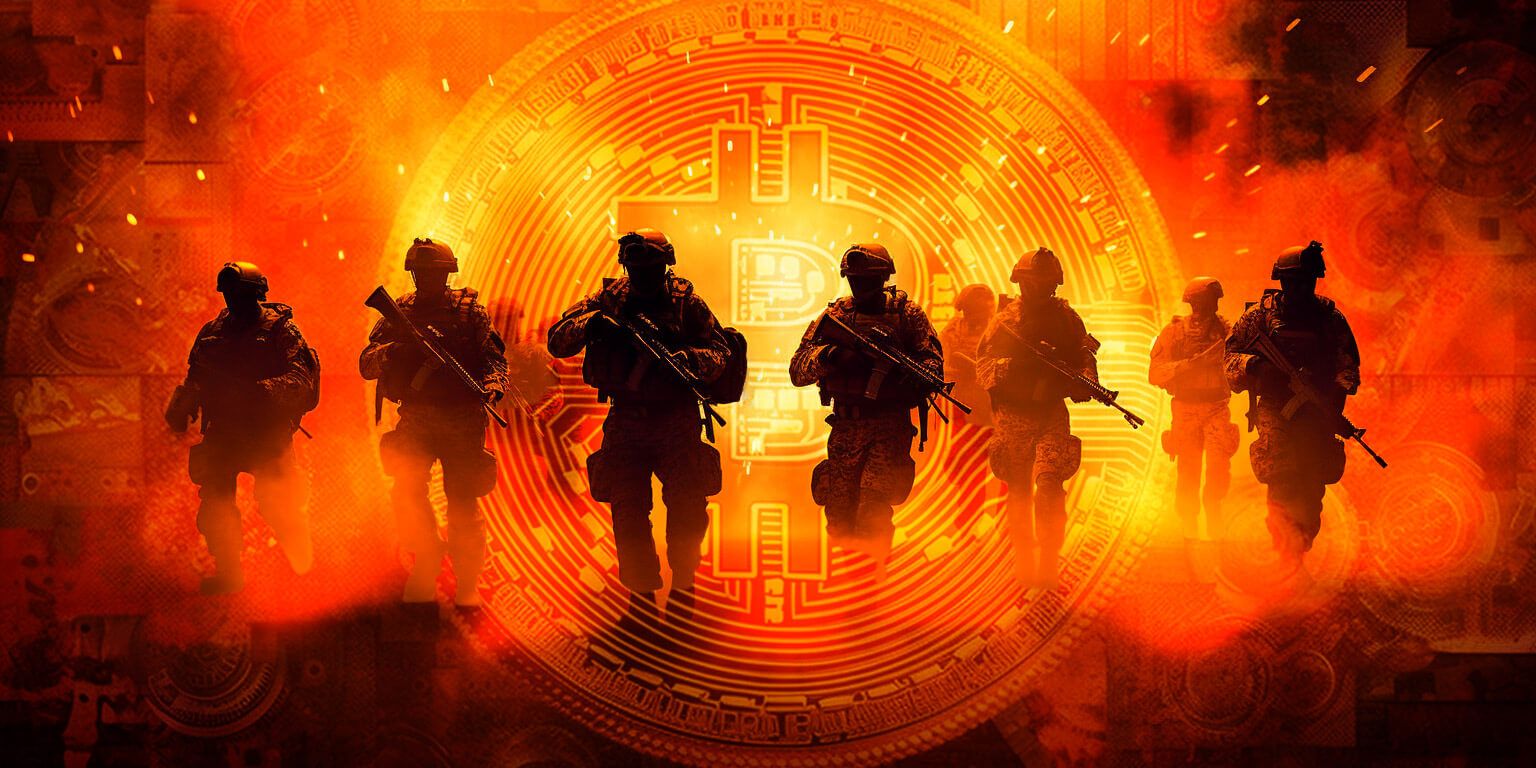
“Make War Expensive Again” is a Bitcoin slogan proposed in a recent tweet by Adam Ortolf from Upstream Data. He maintained that war has become “100% free (+ insanely profitable)” due to governments’ ability to create billions of dollars at will for military spending.
Yet, could a transition to Bitcoin—a form of hard money—truly render war unaffordable? The concept certainly isn’t new, but it is a fascinating debate. Back in 2014, Roger Ver stated
“Every time you use Bitcoin, you are helping to undermine the war machines around the world, and the power of those who would use violence to control others.”
Bitcoin vs. War
Bitcoin and its proponents have long argued that the digital currency could usher in a new era of sound money. Unlike traditional fiat currencies, which are prone to inflation and manipulation by central banks, Bitcoin has a fixed supply of 21 million coins, ensuring its scarcity. In theory, this limited supply could make Bitcoin less susceptible to currency debasement and prompt governments to adopt more fiscally-responsible behavior.
How does this relate to war? Historically, wars have been financed through inflationary mechanisms, such as printing money. This practice enables governments to fund military operations without immediate financial consequences. Instead, costs are passed on to citizens through higher prices and a weaker currency. Adopting Bitcoin or other hard currencies could restrict this seemingly endless spending capability.
As Saifedean Ammous wrote in his infamous book, The Bitcoin Standard,
“For as long as the government could print more money and have that money accepted by its citizens and foreigners, it could keep financing the war.”
It is a feasible assumption that limiting governments’ finances could deter countries from engaging in large-scale military interventions. However, when facing the inability to inflate war-related debts, nations might resort to alternative strategies, including diplomacy and other non-combat measures, to resolve disputes.
In his book Soft War, U.S. Space Force Major Jason Lowery goes as far as to say the U.S. should stockpile Bitcoin as Bitcoin mining will be the battleground of the future. He called Bitcoin
“A national strategic imperative that the U.S. should support and adopt as quickly as possible, else it risks losing its lead as a global superpower in the 21st century.”
A nonviolent revolution
In response to Ortolf, Taiwandan, an Advisor to El Salvador’s National Digital Assets Commission, raised concerns about the potential consequences of transitioning to a Bitcoin standard. While he agreed that hard money could make war more expensive and less likely, he questioned how this transition would occur without resulting in a dystopian future. An interesting take given El Salvador’s move to adopt Bitcoin has been highly publicized.
Taiwandan suggested that, as nations move toward the Bitcoin standard, those with the ability to print money may do so excessively to build up a war chest of weaponry and ultimately lead to one dominating power or dictator controlling the global landscape.
Ortolf’s rebuttal focused on the belief that the transition to hard money won’t be a decision made by governments willingly but rather a change that occurs when the market no longer values the fiat money provided by governments. According to him, the world can collectively opt out of the current financial system by demanding hard money for goods and services.
“The market decides by no longer valuing the paper the Gov’s try to pay with. It’s not a decision governments make other than because they have to.
The world opts out of the scam by demanding hard money for goods & services. A nonviolent revolution.”
Can Bitcoin stop “forever wars”?
It is crucial to understand that war isn’t simply a financial equation. Material conflicts are often exacerbated by ideological, religious, and nationalistic motivations that economic factors alone cannot quickly quell. Furthermore, powerful nations are unlikely to cease their profitable defense industries merely because funding becomes more challenging. Governments may seek alternative funding methods, such as higher taxes, borrowing, or even compelling contributions from the private sector.
So while the notion of Bitcoin making war expensive and reducing its frequency is attractive, the path to achieving this goal is far from straightforward. Therefore, a nuanced understanding of global conflict dynamics and the potential challenges and risks of transitioning to a cryptocurrency-based economy is essential.
Ultimately, Bitcoin’s role in making war expensive again may be an appealing concept. Still, it could also lead to unintended consequences such as higher taxes, increased borrowing, or coercive measures targeting the private sector.
[ad_2]
Source link